EHN Awards 2026 | Award winners showcase innovation, dedication and excellence across the empty homes sector
Latest news
June 3, 2026
Presented at the Empty Homes Network National Conference in Birmingham on 20th May, the EHN Awards provide an opportunity to recognise and celebrate the outstanding work undertaken by empty homes officers, practitioners, local authorities and partner organisations across the country.
The awards showcase the dedication, innovation and determination that underpin empty homes work, while providing national recognition for those making a significant difference in their communities. This year's nominations highlighted an exceptional breadth of achievement, from pioneering approaches to enforcement and service delivery, to transformative partnership working, creative engagement initiatives and remarkable individual commitment.
The Empty Homes Network Awards not only celebrate success but also help share best practice across the sector, demonstrating the positive impact that can be achieved through persistence, collaboration and expertise. We are delighted to recognise this year's winners and highly commended nominees, whose achievements are highlighted below.
Highly Commended: David Shari-Fae, Wychavon District Council
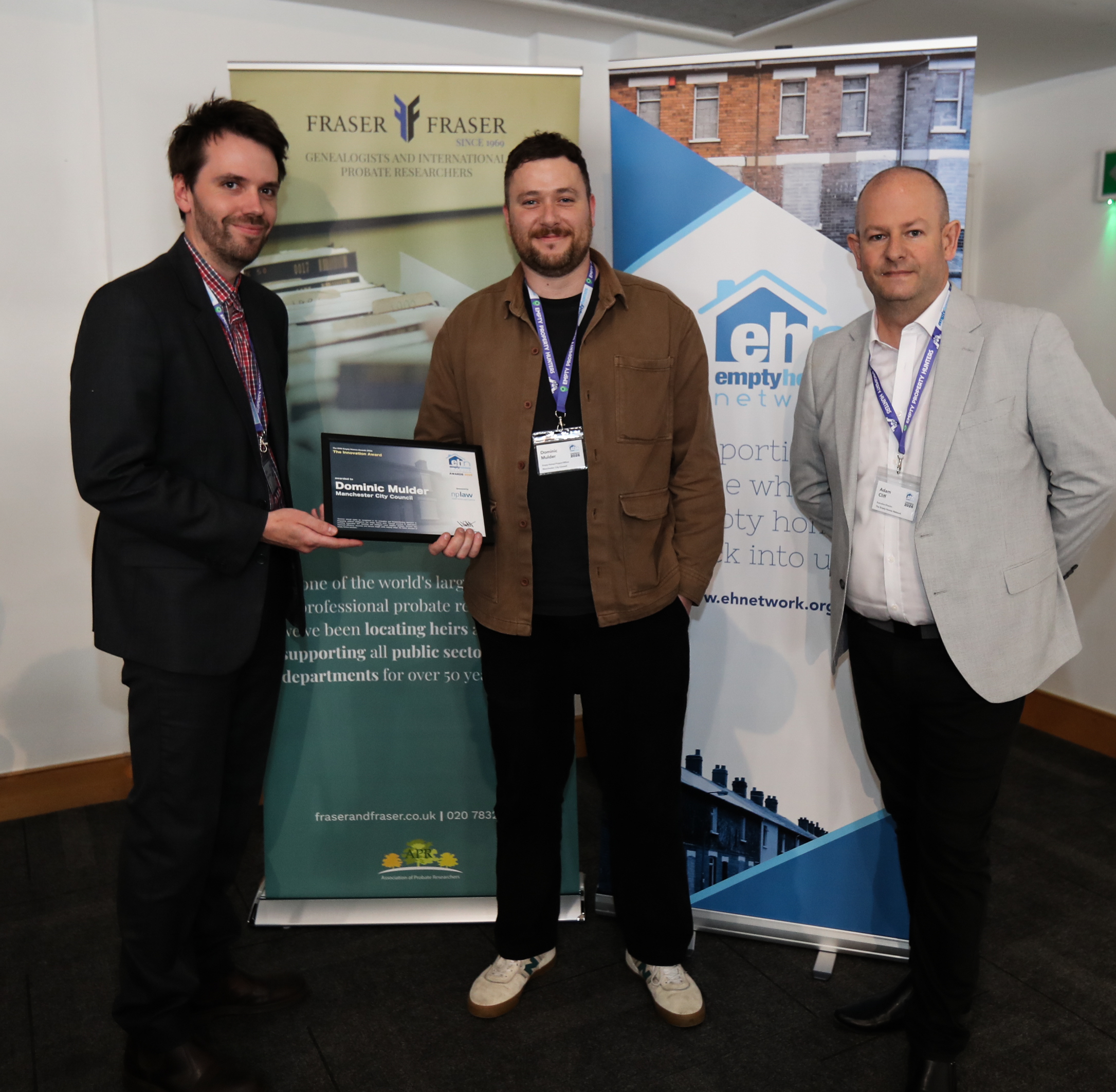
Winner: Dominic Mulder, Manchester City Council
Artificial Intelligence is becoming more a part of every day life but how to utilise it effectively for the work of empty homes was not immediately obvious because so much of our work is out in the community and built on relationships with owners/beneficiaries. Dom, however, was one of the earliest adopters of AI in our office and very much champions the use of AI in our day to day work helping to make our service more streamlined and offering more insights into data trends.
One example would be how Dom used co-pilot systems to help automate our KPI reporting. By working with AI he was able to set up a series of running total generators so we can run any KPI data we need at any time of the month. This has made our way of working more agile and means we have more oversight over the service day to say. It also helps to identify any information that may have been entered incorrectly meaning our reporting is more accurate.
Another example would be the utilising of AI to format the large amount of land registry data. Dom, in conjunction with our IT team, looked for ways to sift through the large list of land registry price paid data each month. In using AI they were able to isolate any properties open to us that had any changes the previous month. Doing this meant we knew which properties to check rather than having to check each individual case. It is significantly quicker and prevents officers from doing unnecessary checks.
Dom has in recent works undertaken specific AI training to learn additional skills and how to practically apply AI programs to our work. Since that time Dom has continued to promote the use of AI within the team and wider service and no doubt will make further improvements in our service delivery with these tools. At this point we just refer to him as Q (for some reason he didn’t like the title Digital Yoda).
On selecting the winner of this award, the judging panel said: “Dominic should rightly be recognised or his innovative and forward-thinking approach to integrating artificial intelligence into empty homes work. Through practical AI applications including automated KPI reporting and intelligent Land Registry analysis, Dominic has improved efficiency, accuracy and service insight while helping shape the future direction of empty homes services.”
Highly Commended: David Shari-Fae, Wychavon District Council | Louise Cowings & Kelly Fullard, Durham County Council
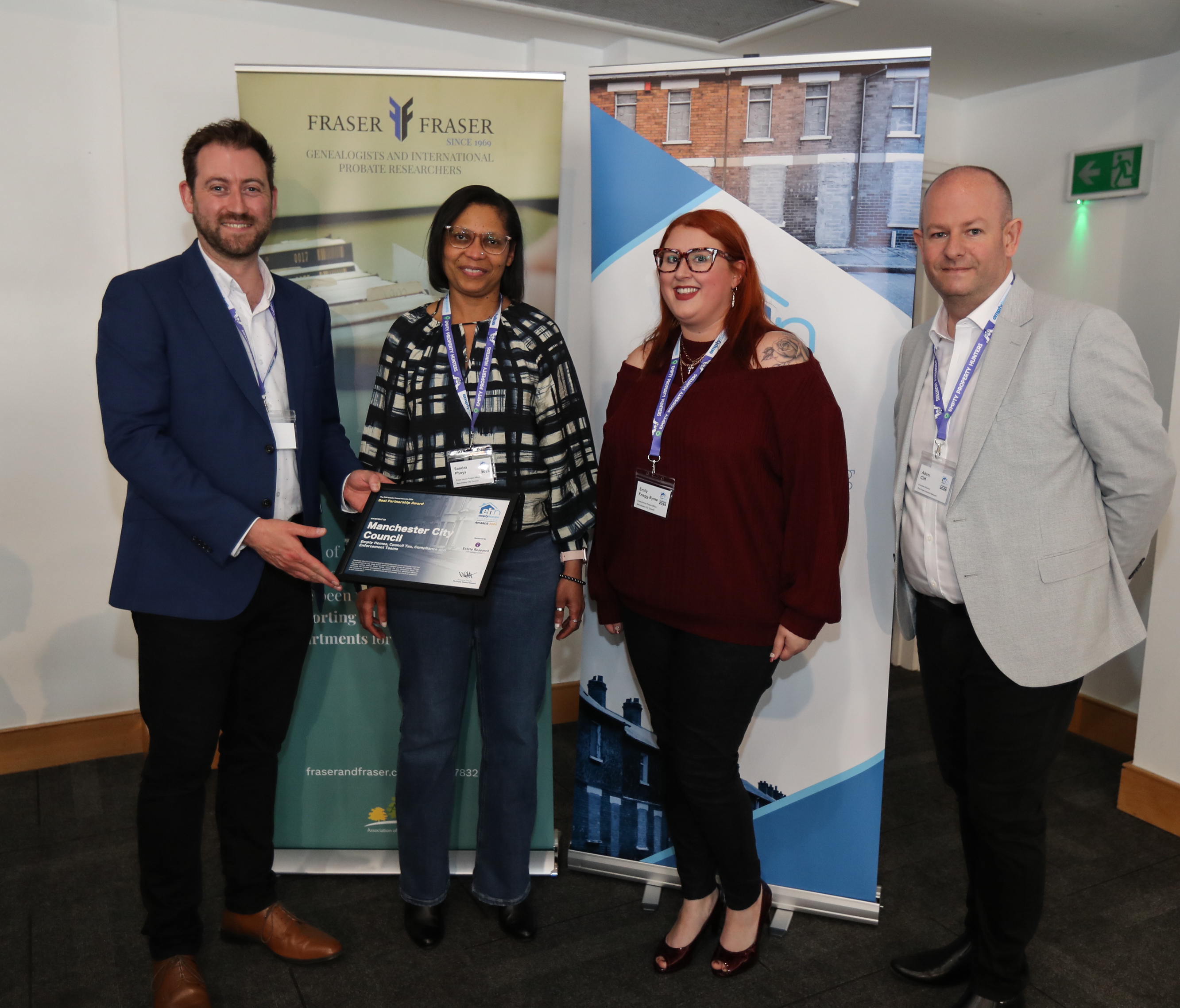
Winner: Manchester City Council, Empty Homes, Council Tax, Revenue & Benefits, Compliance and Enforcement Teams
Since it’s inception, the Empty Homes Team at Manchester City Council were keen to liaise with other parts of the council. Empty Homes in the few years prior did not have a dedicated team and so some properties fell through the cracks. It was disjointed with one team dealt with different issues for the same property as another. The Empty Homes team then made it a priority to begin connecting with other services, specifically Council Tax and Compliance, to streamline our approach.
Our initial contact with Council Tax was a monthly meeting where we would discuss our progress in terms of setting up our service and a broader overview of our service. However, as we have progressed this relationship with Council Tax has developed into a very collaborative partnership. Our service has a probate register so council tax are informed as soon as we are that probate has been granted allowing them to start charging premiums earlier than we may have missed for several months otherwise driving revenue. Once a month we have a case panel meeting where both services can bring up any cases we want to discuss jointly, share information and work out how best to proceed. These case panels have been very productive in finding solutions and ensures that any correspondence with an owner from either team is giving a consistent message.
Collaborative training is also part of our process. For example, new Council Tax Visiting Officers spend several days shadowing our service and learning how we work and assess empty homes. Our service is also assisting with the recruitment of these officers as we will be working so closely together day to day.
Similarly with Compliance services we had initial monthly meetings to update on our progress but these have again developed into more of a case panel where both sides can highlight particularly problematic cases and see how we can work jointly to bring about a positive resolution. We also conduct joint visits with Compliance officers in some cases and maintain an open dialogue, so everyone is on the same page and owners are receiving consistent messaging from MCC.
The Empty Homes Team is also acting as a bridge of communication between Council Tax and Compliance who traditionally worked independently of one another and our service was finding in some cases one team telling us to talk to another which was unhelpful for us and meant we were spending more time than necessary trying to obtain information. For example, both may have charges against the same property but neither would decide who would take the case forward for an enforced sale. To help, our service arranged regular joint case panels between us and both other services making decisions and responsibility more transparent for all involve. This collaborative working has been a game changer for us and we can go back to owner’s with all of the relevant information.
On selecting the winner of this award, the judging panel said: “Manchester City Council has developed an outstanding cross-service partnership model that has transformed the way empty homes cases are managed across the authority. Through integrated working between Empty Homes, Council Tax and Compliance teams, the partnership has improved communication, enforcement coordination, operational efficiency and outcomes for its residents, neighbourhoods and communities, and should be applauded for their collaboration.”
Highly Commended: David Watts, Knowsley Council | Alex Chaplin, Manchester City Council | David Shari-Fae, Wychavon District Council
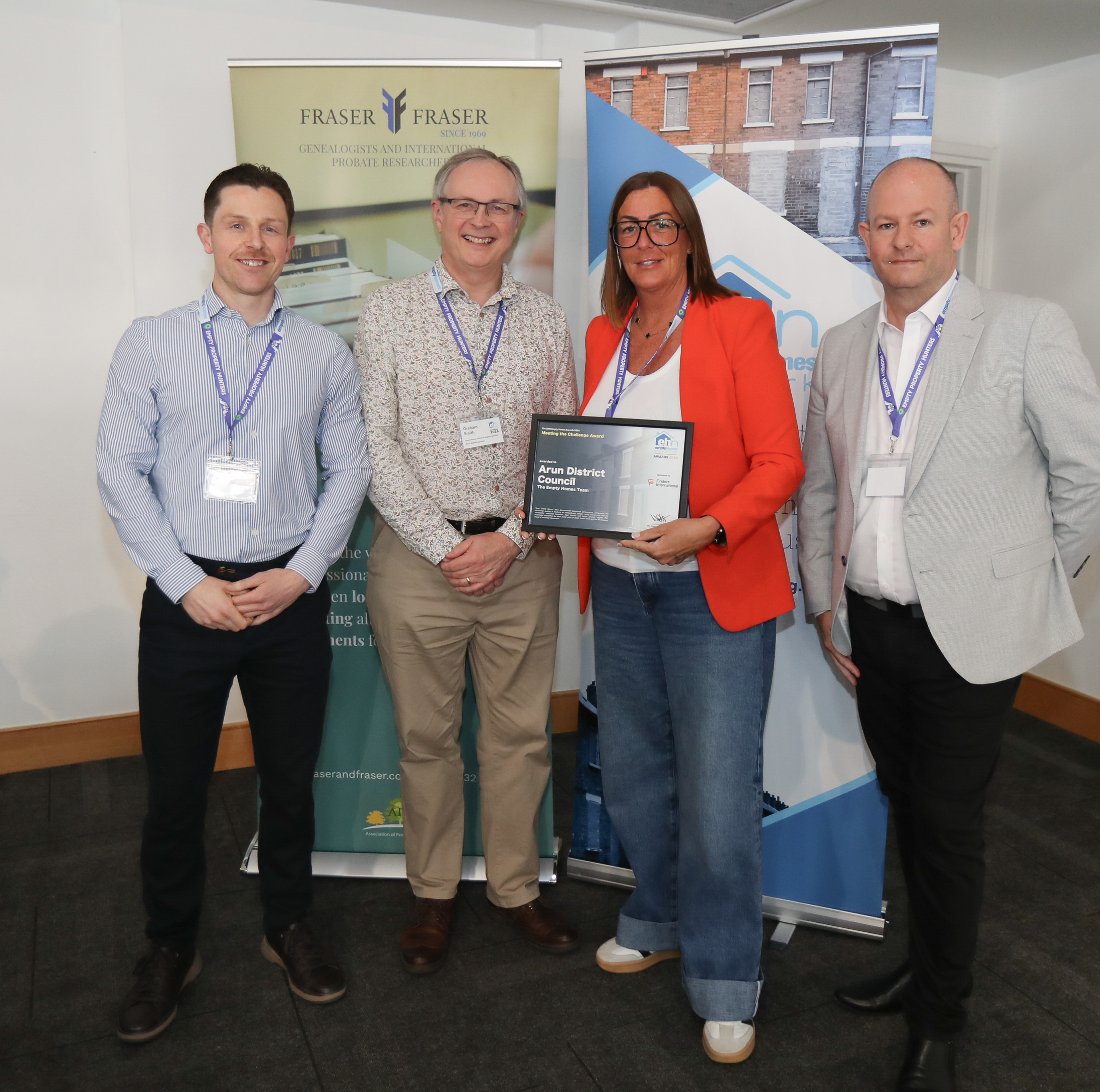
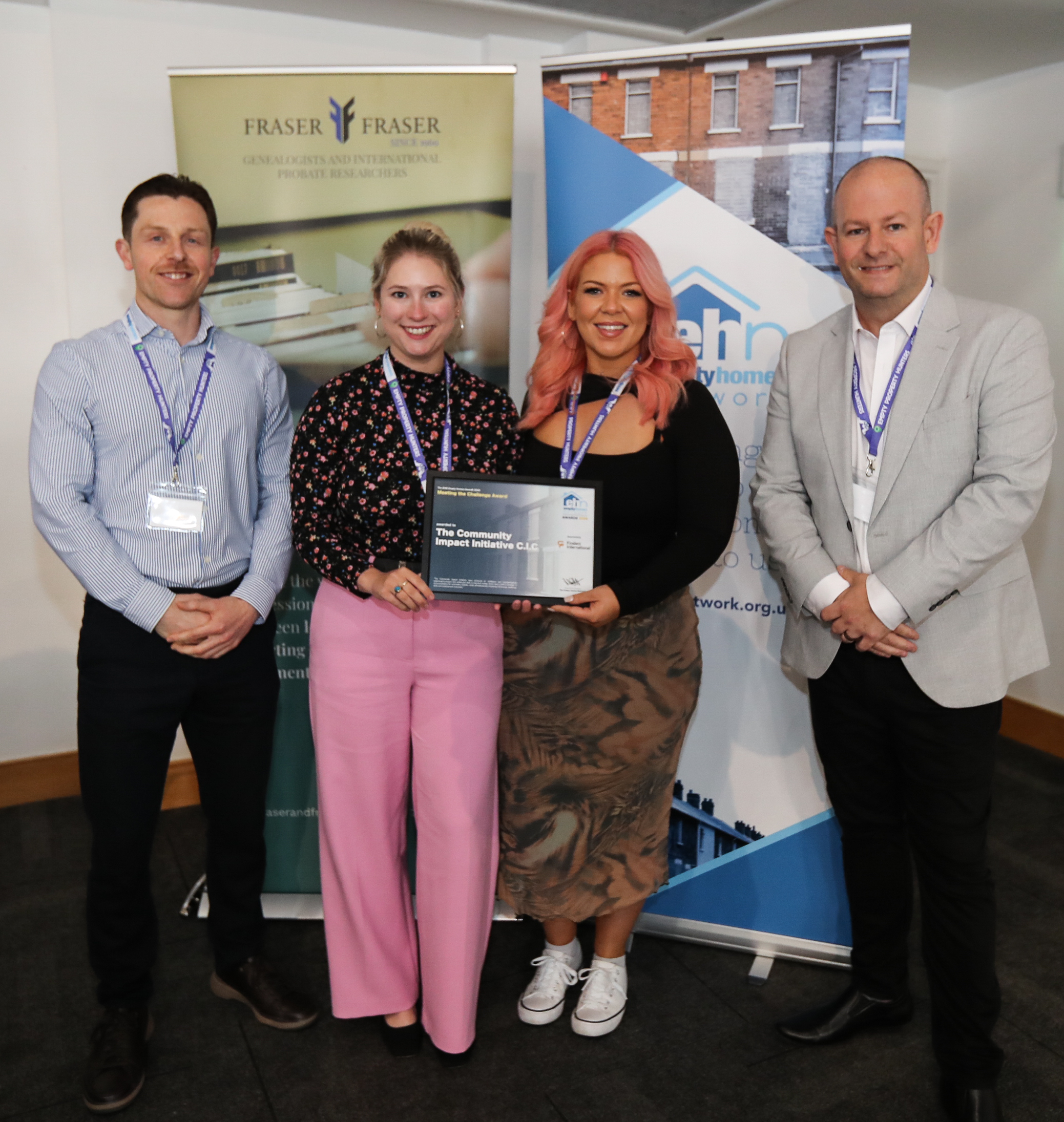
Joint Winners: Empty Homes Team, Arun District Council | The Community Impact Initiative
In 2022 a property was reported as empty to the Empty Homes team. The report claimed it had been empty for at least 3 years and was in a terrible overgrown condition. A large tree in the garden had fallen in the storms causing damage to the neighbouring property. There had been historic, ongoing drug use and anti-social behaviour which had resulted in the owner leaving and the Police closing the property.
A drive-by of the property corroborated the report received. Investigations began with council tax, land registry, the police, anti-social behaviour team and the neighbours. The information being received alluded to the property being privately owned by a person who had been forced to leave due to cuckooing and county lines drug misuse at the property. After contacting the owner on a historic mobile number held on council tax records, we ascertained that they had purchased the property in 2019 but was forced to leave due to the anti-social behaviour, drug misuse and their declining health. They had no intention of returning to the property and agreed to hand over the keys so we could undertake a full inspection using the legislation under the Housing Act 2004. Internally, there was damage to ceilings from an historic water leak from the loft, soiled mattresses and drug paraphernalia to most of the rooms.
The rear garden was heavily overgown and thick with vegetation up to roof height and the front of the property was partially covered in ivy. It stuck out like a sore thumb on what is a well-kept street on the district. Prevention of Damage by Pests Act Notice was served to create a charge and enforce the sale of the property.
Fast forward to 2026.
The Team have built up a strong rapport with the homeowner which resulted in a priority housing need being identified and Temporary Accommodation being provided in 2024. Works in default to clear the gardens and house were carried out, in 2023, to facilitate an enforced sale, which turned out could not be enforced due to a restriction on the land registry title which prevented the property being sold without the express consent of a family member.
The owner was estranged from the family and was unwilling to engage in conversations with them to move things forward. The priority, in 2025, shifted to getting the homeowner back into the property, due to declining health, which was now an empty shell with no heating or hot water and required an assortment of signposting referrals to the CAB and charities in order for funding to be obtained, the owner was on Universal Credit and ‘cash poor property rich’.
With the support of the EH team in February 2026 a solicitor was appointed to carry out the conveyancing work on account and to obtain the permissions to have the restriction removed. Once sold, the LA will get its debt repaid and the homeowner can move onto alternative accommodation that is more suitable for their needs and for this property to be renovated and occupied fully, as a family home.
On selecting Joint Winners for this category, the panel said of the first: “Arun District Council have demonstrated exceptional perseverance, compassion and partnership working in resolving an extraordinarily complex empty homes case involving vulnerability, anti-social behaviour, legal barriers and severe property neglect. This submission exemplifies the wider social value of empty homes work and the life-changing impact of sustained intervention.”
Last year, the Health and Social Care (Wales) Act 2025 removed profit from the care of looked-after children. Without the means to make a profit on their facilities, many large children’s care home providers removed their business from Wales, creating a drastic housing crisis for children in need of residential care.
To meet this challenge, we collaborated with not-for-profit children’s residential care home providers, Tai Heulwen, who, despite extensive research, were unable to identify a suitable, affordable property for the residential care of vulnerable children.
We worked alongside Tai Heulwen to locate a long-term empty home, which, with substantial development, had the potential to meet the housing needs of looked-after children.
The Cii purchased the large 3-floor property in Dowlais, Merthyr Tydfil, which had been empty for 10 years and required significant work and approvals to bring it to standard.
We quickly set to work with engaging the community in the regeneration, and welcomed 43 local people on site to take part in the renovation and retrofit activities, which included bringing the property back to brick, drastic roof repairs and the relandscaping of the entire outdoor space.
Throughout the project, we saw significant positive developments in the wellbeing, skillset and future aspirations of the community members who took part, several of whom had experience in the care system themselves.
Since joining the project;
· 84% of participants reported an improvement in their mental health, welfare and confidence.
· 88% of participants reported feeling more connected to their community.
· 88% of participants reported feeling more positive about themselves and their future.
· 84% of participants progressed to employment or further education.
After a year-long regeneration, the property is unrecognisable, and with some final touches, it will open as a children’s residential care home run by Tai Heulwen in Summer 2026.
This project is a groundbreaking example of how, led by the Cii, two not-for-profit organisations and the local community came together to overcome not just the physical challenges of regenerating a long-term empty home, but also the negative perceptions and housing needs for vulnerable looked-after children.
This regeneration is triple the scale of any previous Cii project and reflects the Cii’s commitment to being proactive and ambitious in transforming long-term empty properties into homes for people who need them most.
On the second joint winner of this award, the panel said: “The Community Impact Initiative have delivered an ambitious and transformational regeneration project that addressed both a long-term empty home and a critical shortage of accommodation for vulnerable children, while simultaneously improving community wellbeing, skills and employment outcomes.”
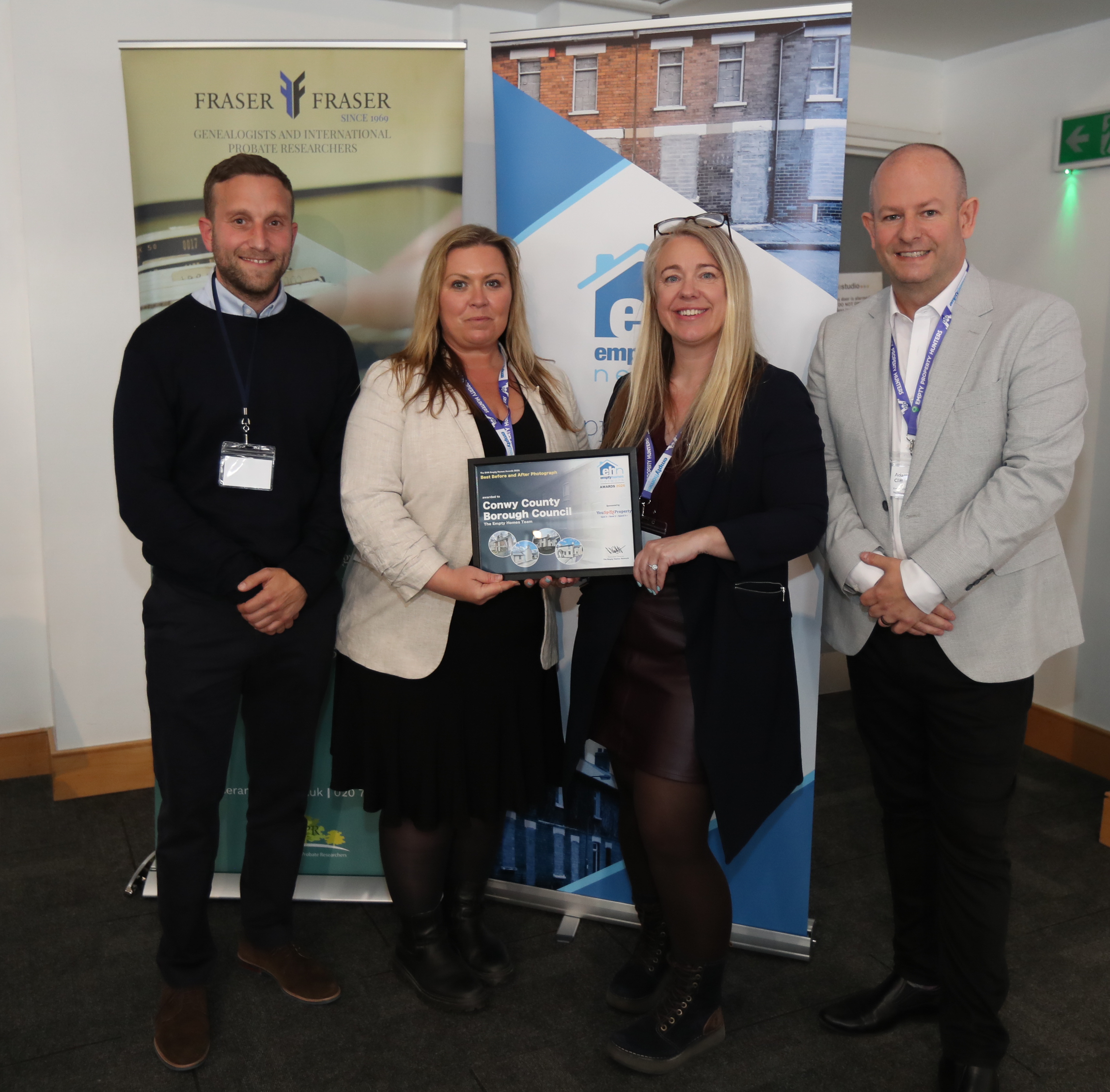
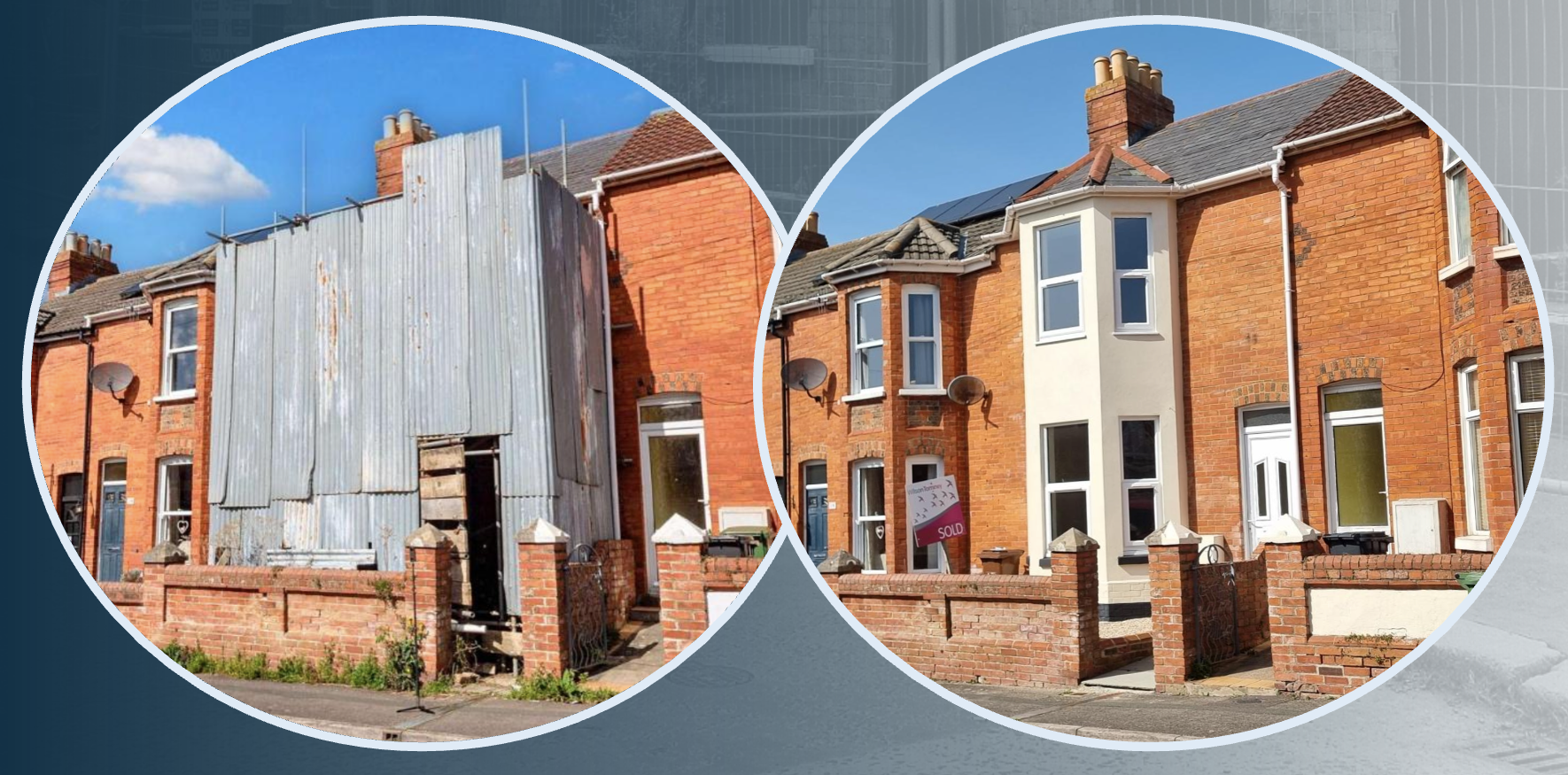
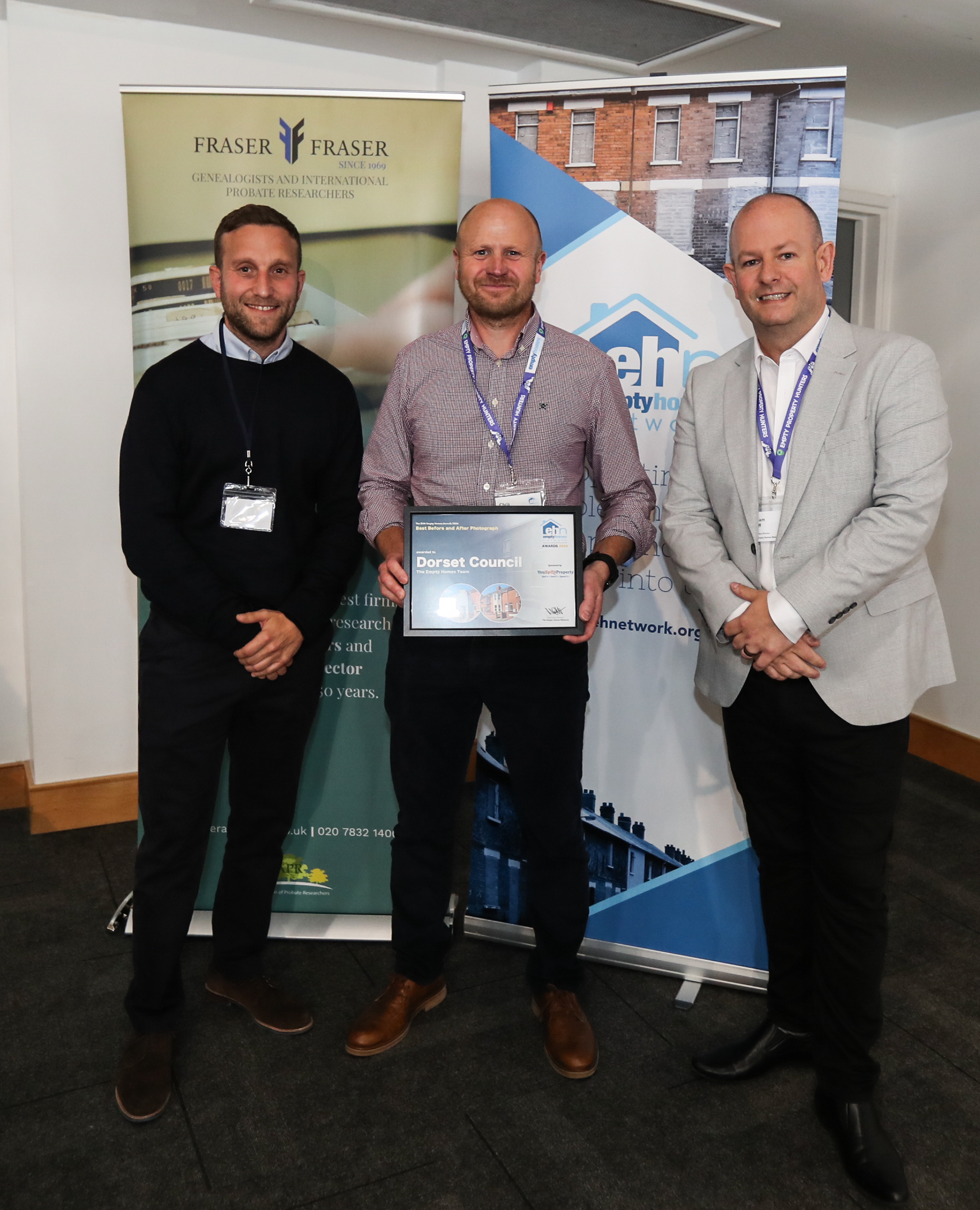
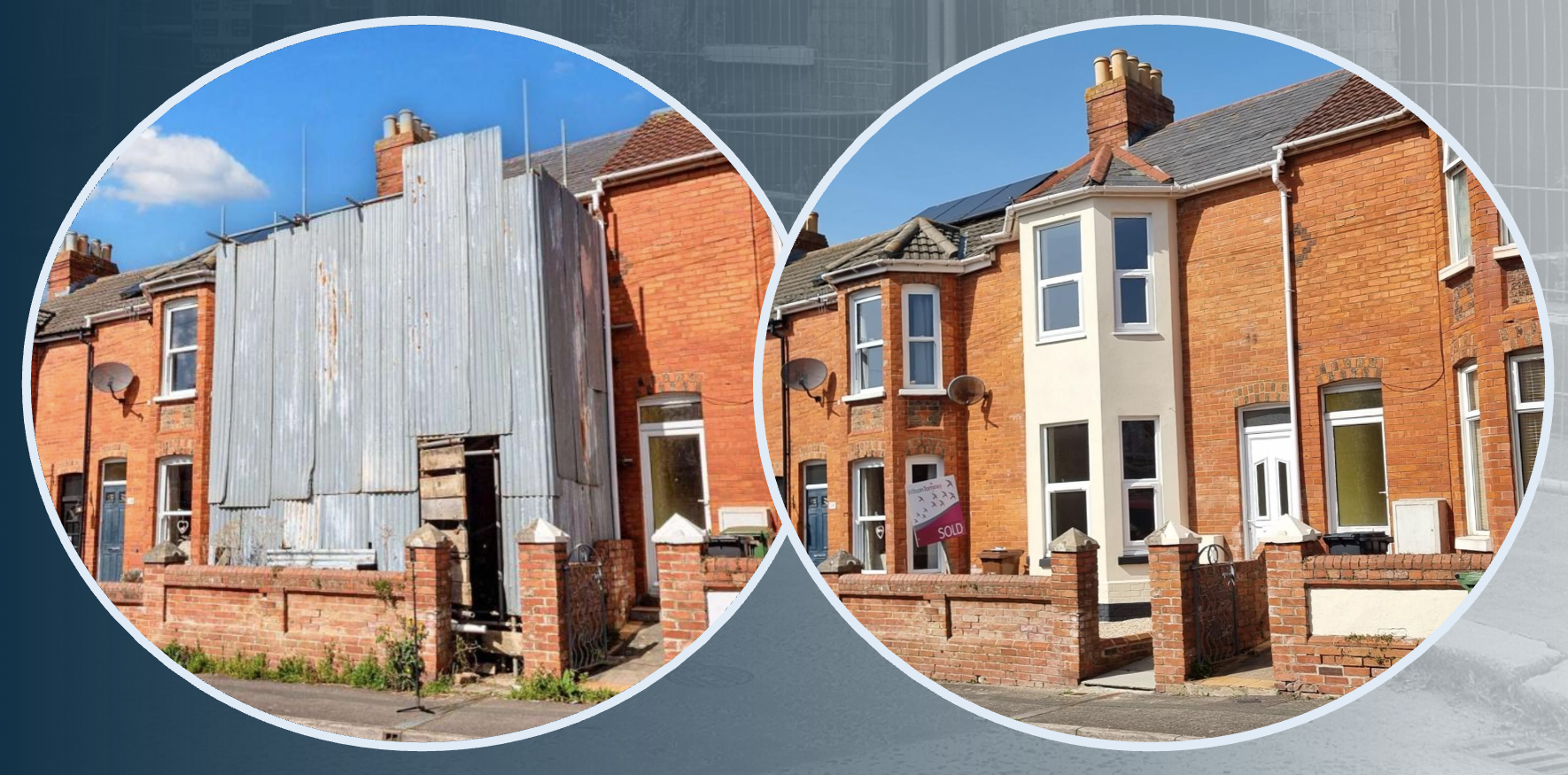
Best Before and After Photograph Award – Sponsored by YouSpotProperty
Highly Commended: Cumberland Council, Lancaster City Council, Arun District Council, Durham County Council
Joint Winners: Conwy County Borough Council | Dorset Council
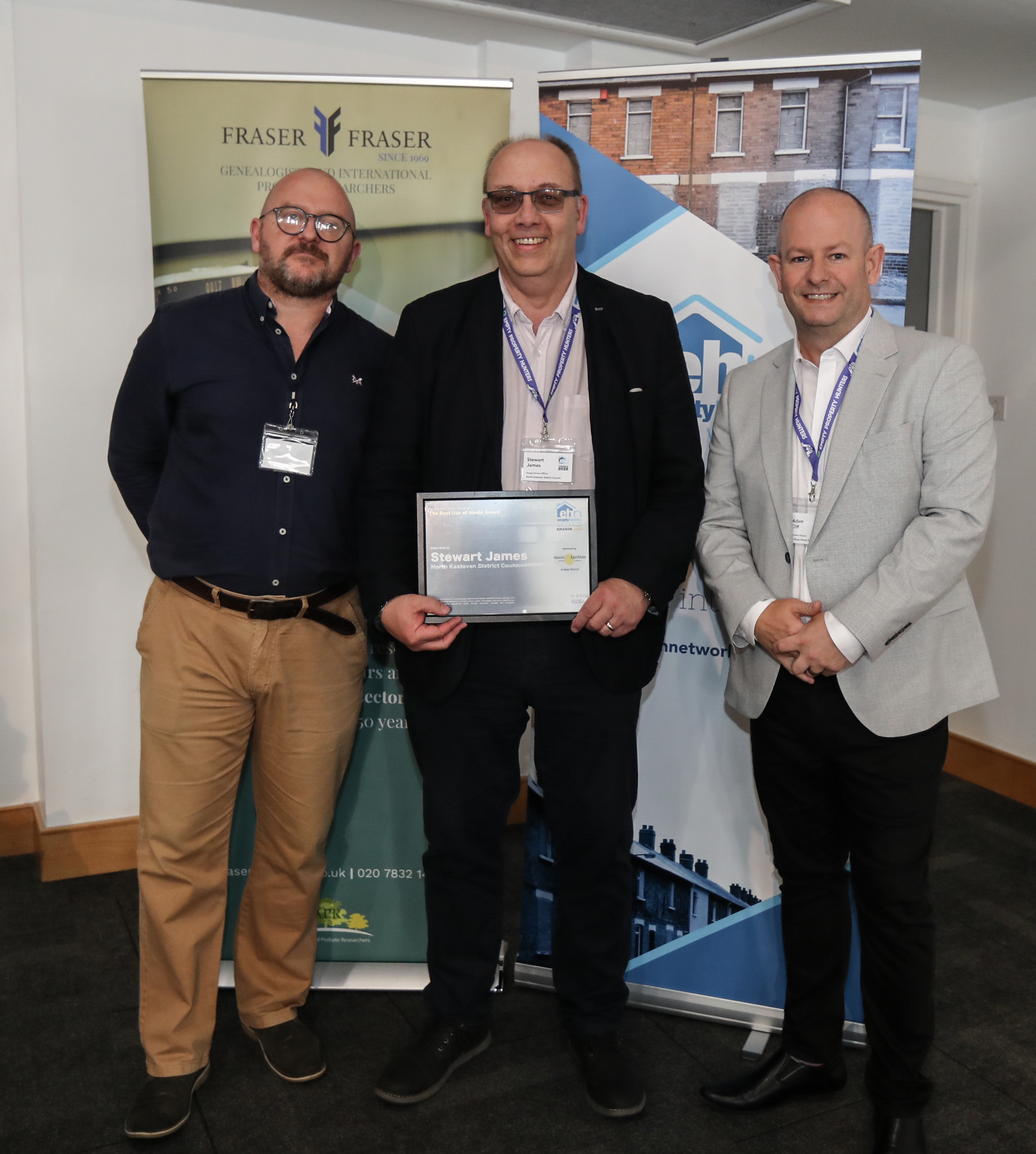
This year for our Empty Homes week we launched a new poster, flyer, and advert which we have provided to all our Parish and Town councils for display. Rather than use the media for just the empty homes week, we decided to not date the poster so that it could be an ongoing way of being an eye-catching poster which advertises our services but also encourages neighbours and residents to report empty homes. The poster/advert/media gives a positive image and has been praised by council members and our residents as it shows a progression of a property.
Considering this started as a very rough design I did on the publisher app, the reprographics team here at North Kesteven took my basic idea and ran with it. It now comes in A3, A4, A5 and A7 sizes. When I inspect reported or known empty properties the flyer can be put through the letterbox of the property, so if visited by the owner they will see it and hopefully engage. The image has been shared on our social media accounts.
In June, the poster/advert will be released in a free community magazine with a distribution of over 22,000 homes within the North Kesteven district.
Already we have seen the success of the poster in our parish o`ices where residents have reported previously unknown empty homes where owners had provided false information into their occupancy to our council tax team. Others have reported already known empty homes and we have found additional information from some of these callers about the ownership and the addresses of these owners.
On selecting the winner of this award, the judging panel said: “Stewart has delivered an exceptionally effective and visually compelling media campaign that successfully raised awareness of empty homes issues, encouraged community reporting and generated tangible operational results through innovative, reusable and accessible communications.”
Highly Commended: David George, Malvern Hills District Council | Emily Drury, Empty Property Hunters
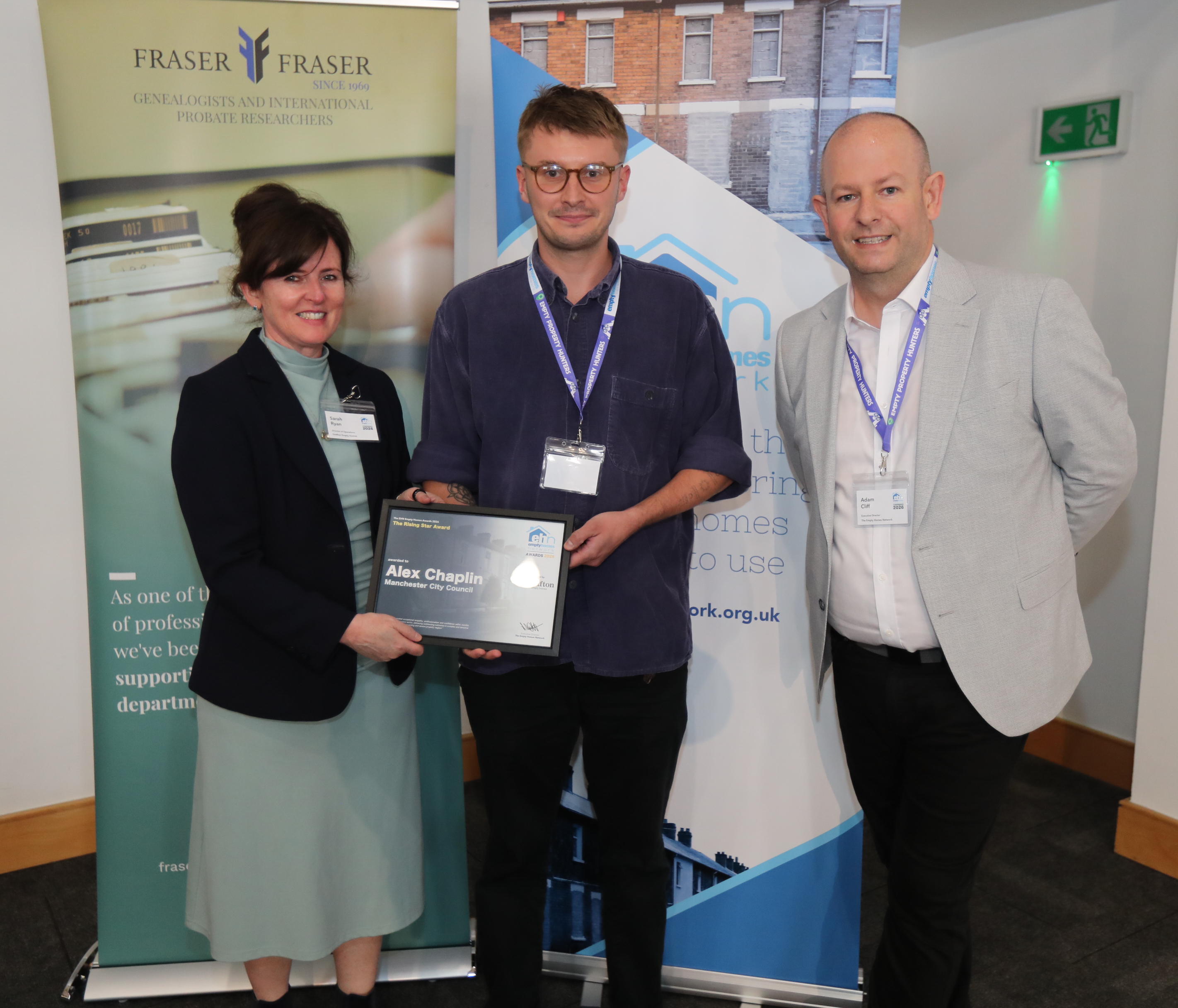
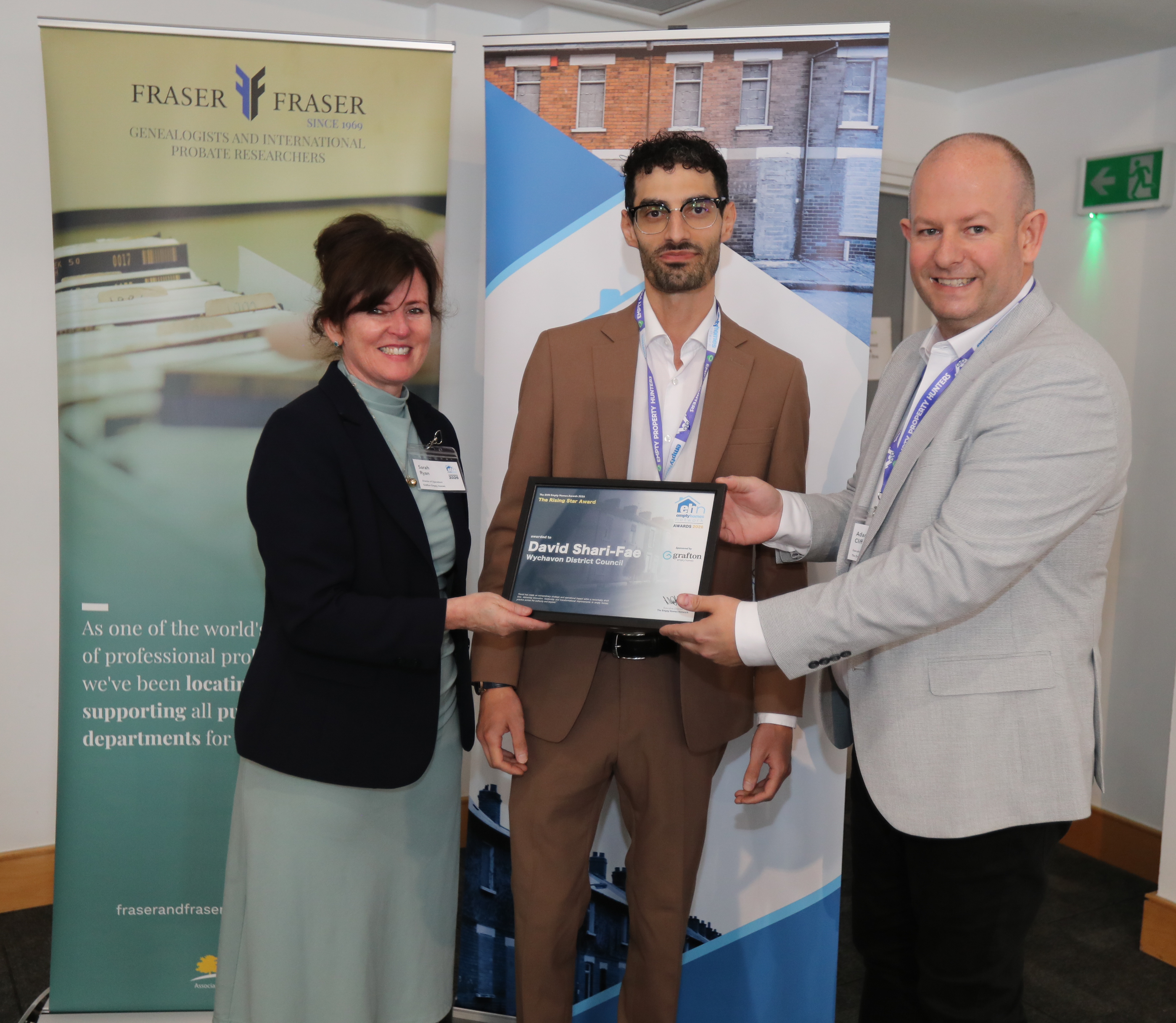
Joint Winners: Alex Chaplin, Manchester City Council | David Shari-Fae, Wychavon District Council
After coming into post in only January this year, Alex has come out of the gate storming and has had a huge impact on the service. Within his first week, Alex was already picking up cases and had no hesitations in visiting properties, calling owners and having those difficult conversations picking up our processes and policies quickly.
Alex’s confidence shines through. He is very warm and down to earth which means he is able to build great relationships with owners/beneficiaries. One example is a recent case in North Manchester that had been referred to us due to neighbours complaining about pests. The property had been empty for some time but externally did not look to be in bad condition nor did it have any of the usual indicators of being an empty home. Through his enquiries Alex was able to contact the owner and establish a dialogue. The owner was a single person who struggled with their mental health and was a prolific hoarder. Alex was calm and understanding allowing the owner to be comfortable enough to share this information and explain that she had abandoned the property because of the hoarding and had been living in hotels too ashamed to tell her parents for the last year.
Alex worked with other services including adult social care and our compliance team to help. Alex arranged a joint visit to the property where they were able to go inside and see how bad a condition the house was in. The property was full of rubbish and the floor barely visible to the point where it is clearly uninhabitable. Alex was compassionate throughout this whole process and worked with the other services to make sure the owner was fully supported. With this support, the owner allowed for a crisis clean to be conducted, pest control and compliance works completed. This would allow the owner to sell the property and would help to mitigate the issues for neighbouring properties.
The owner then chose to sell the property via our service’s investor register as she did want the burden of maintaining the house and it would free up the capital as the hotel stays were expensive. Alex was very supportive of the owner throughout this process and as a result her quality of life drastically improved. An offer has now been accepted for a member of our investor register to purchase the home, renovate it and bring it back into use. This is increasing housing stock in a high demand area, allowed the owner the new start they wanted and the lives of the residents have improved. Alex was instrumental from start to finish and it is down to his ability to build strong relationships that we have ended with such a positive outcome for all involved.
On selecting our first of two joint winers of this award, the panel said: “Alex has demonstrated exceptional empathy, professionalism and confidence within months of entering the empty homes sector, delivering outstanding outcomes in complex and sensitive cases involving vulnerability, hoarding and severe property neglect.”
Since coming into post, David has achieved some significant successes having becoming an Empty Homes Officer on 2nd June 2025.
Loan Scheme
Created a new Empty Homes Loan Scheme, the first of its kind in the County. This included developing paperwork ranging from application form, policy, eligibility criteria and internal processes to the legal agreement itself. The loan scheme will provide owners with an added incentive payments if they rent the property to applicants on the housing waiting list thus helping to turn empty properties into homes for the vulnerable.
Transforming the Council’s Online Presence – Empty Homes Hub
Completely redesigned the council’s empty homes web content, transforming it from a single, basic reporting page into a comprehensive Empty Homes Hub. The hub now provides clear, accessible information across several pages on incentives, VAT discounts, council tax premiums, enforcement options, owner responsibilities and cost of owning an empty home in Wychavon. This has improved transparency, reduced unnecessary enquiries and given owners the tools to act earlier and more confidently.
Improving Case Management and Supporting Other Authorities
To improve oversight and efficiency, I created a bespoke Excel based case management spreadsheet with built in formulas. This includes a traffic light prioritisation system, automated reminders showing when each case was last worked on and summary box which categorises properties and provides automated totals for monitoring and reporting. I then shared this sheet and its tools with a neighbouring council district, helping them improve their own empty homes management with regular ongoing support.
Raising Strategic Awareness
I released insightful quarterly reports for Council Leaders to showcase progress, outcomes and trends. These reports highlight the importance of tackling empty homes and demonstrate the value of this work in addressing wider housing pressures. Such reports have helped position empty homes as a clear strategic priority within the council, receiving consistently positive feedback from Members. They have also significantly increased engagement and interest in empty homes work, to the extent that increased funding is now being considered.
I produced a detailed report analysing properties that had been empty for five years or more. The report identified key barriers to progress, including probate, absent owners, and long-standing disrepair, and categorised cases by likelihood of resolution and appropriate intervention. Its findings are used to prioritise resources, target enforcement and incentives more effectively, and provide clear evidence to members and senior officers of where intervention would have the greatest impact again highlighting the importance of our work.
Unlocking Exemption F Cases
I identified probate cases as a significant barrier and persuaded the Council Tax team to meet genealogists. This collaboration led to an agreement that allowed probate investigations to proceed. As a direct outcome, a property that had been empty for over 12 years is now being managed by genealogists, acting on instruction from next of kin to complete the probate process, renovate and sell the property, unlocking a home that had cost the Council over £25,000 in unpaid Tax payments, and which was attracting Councillor and neighbour complaints as well as wasting emergency services’ resources with call outs.
On selecting the second joint winner of the award, the panel said: “David has made an extraordinary strategic and operational impact within a remarkably short time, delivering innovation, leadership and transformational improvements to empty homes practice across the authority and beyond.”
Empty Homes Practitioner of the Year Award – Sponsored by No Use Empty: Kent
Highly Commended: Sandra Phoya, Manchester City Council
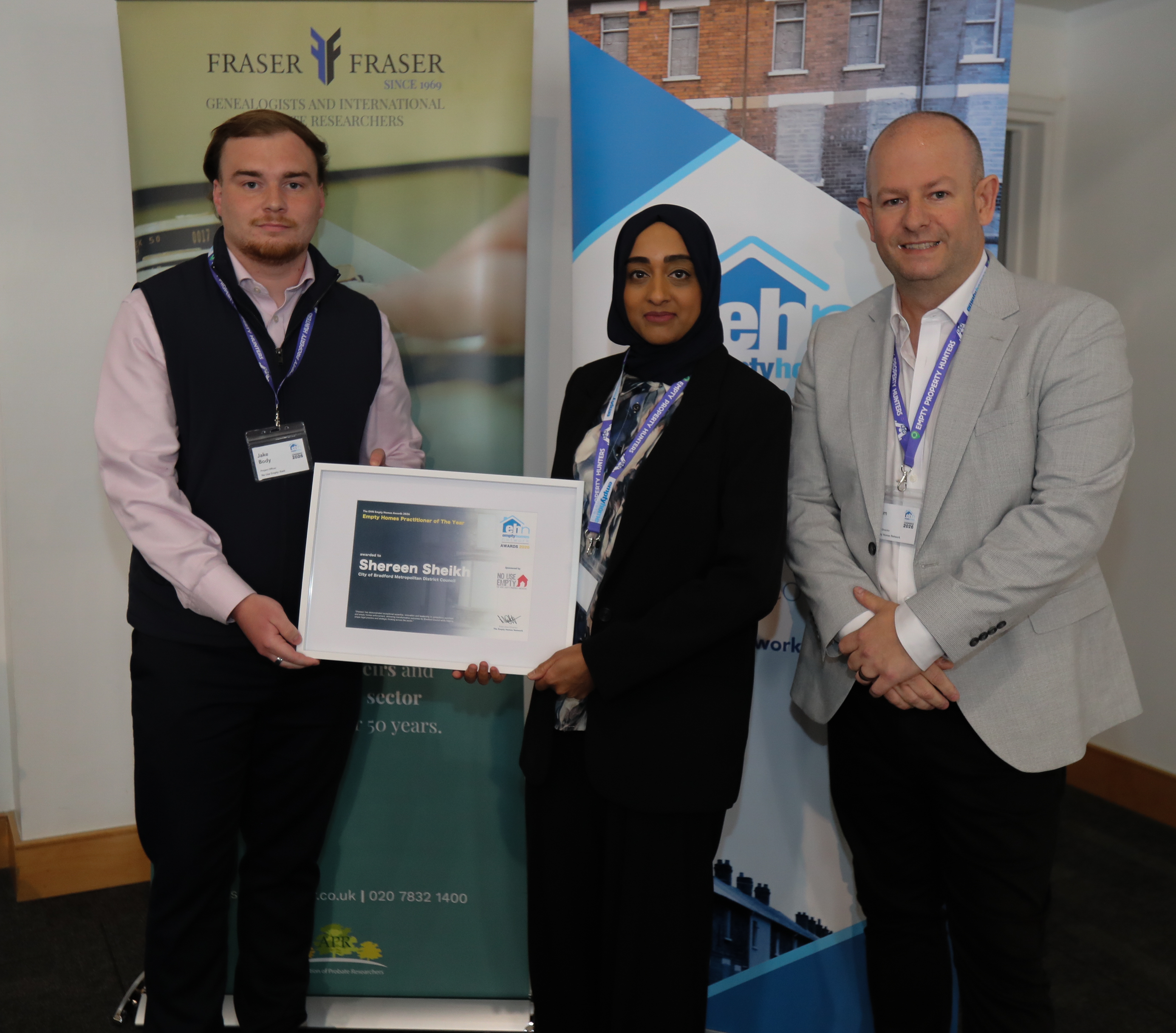
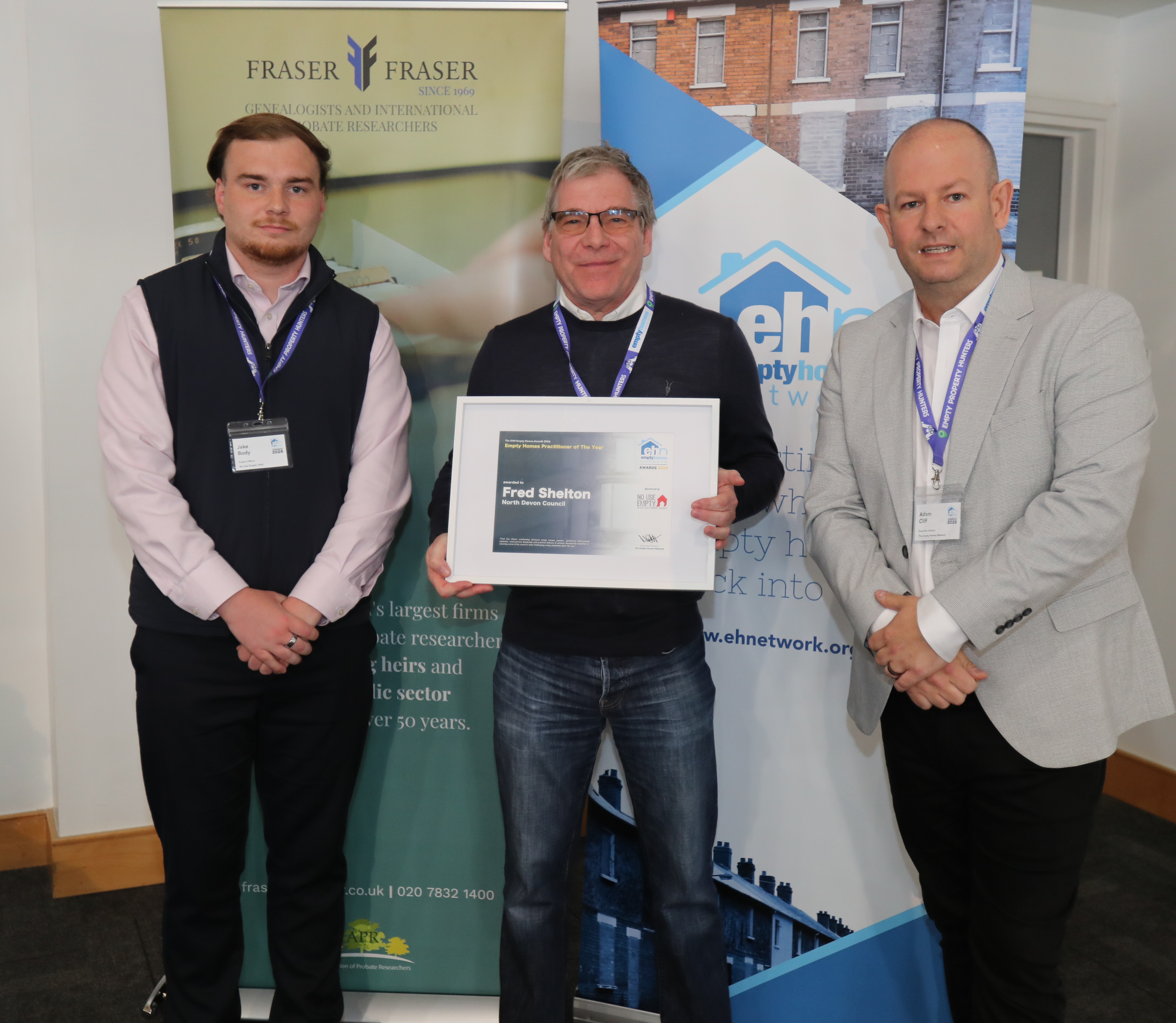
Joint Winners: Shereen Sheikh, Bradford MDC | Fred Shelton, North Devon Council
Shereen is a highly accomplished Lawyer (CPO & Property) dedicated exclusively to Bradford Council’s Empty Homes and Loans Team. Since joining the Council in 2014, she has played a transformative role in strengthening the authority’s approach to compulsory purchase and empty property enforcement. At a time when only a small number of Compulsory Purchase Orders (CPOs) were being progressed, and often with significant delays. Shereen was initially appointed as part-time legal support. She has since become a leading specialist in the field, bringing exceptional expertise in navigating the complex statutory framework underpinning compulsory acquisition.
Shereen’s work spans the full lifecycle of compulsory purchase, including strategy development, negotiation of compensation, handling objections, public inquiries, and representation of the Council at all levels. Her impact is evidenced by her conduct of legal procedures for 63 CPOs and the conveyancing of 51 purchase-by-agreement cases. She has supported officers in 11 public inquiries, achieving an exceptional success rate.
Over the past 12 months, Shereen’s contributions have been particularly noteworthy. She identified a potential miscarriage in a Planning Inspectorate decision and developed the legal arguments for a successful appeal. She also played a pivotal role in establishing new case law, assembling evidence and providing expert input to successfully defend a High Court injunction, resulting in clarified powers relating to the use of a warrant under Section 13 of the Compulsory Purchase Act 1965.
Shereen is also recognised for her innovative approach. She devised a novel method to bring a long-term empty property back into use by negotiating its £1 acquisition from the Crown Estate, coupled with an agreement linked to the eventual auction value. Her expertise in handling complex compensation matters is equally impressive, involving cases with proceeds of crime considerations, multiple claimants, mortgage settlements, and intricate calculations of loss and interest over extended periods.
Her specialist legal knowledge is extensive, including a deep understanding of the Compensation Code, and all procedures relating to compulsory acquisition. However, Shereen’s contribution extends far beyond legal technicalities. She is embedded within the Empty Homes Team from the earliest stages of a case, providing strategic guidance, liaising with banks to resolve stalled possession matters, and advising on properties with unknown ownership or probate complications.
Crucially, Shereen has been instrumental in developing and refining the Council’s end-to-end process from initial engagement with property owners through to CPO, ensuring that all options are explored thoroughly, proportionately, and effectively.
Shereen exemplifies excellence, innovation, and dedication in empty homes law. Her work has not only delivered tangible outcomes in bringing properties back into use but has also strengthened legal practice and set new standards within the sector. She is a truly deserving candidate for this award.
Recognising two outstanding contributions to empty homes work over the past 12 months, the panel said of our first joint winner; “Shereen has demonstrated exceptional expertise, innovation and leadership in compulsory purchase and empty homes enforcement, delivering transformative outcomes for Bradford Council while helping shape legal practice and strategic thinking across the sector.”
“I am the sole empty homes officer in the Council, so it has been crucial for me to nurture cross-service collaboration and take targeted enforcement action. My approach has resulted in some of our most challenging empty homes being brought back into use over the last year.
I have delegated powers across Housing, Environmental Health, Planning and Council Tax, which allows me to consider the most appropriate legislative power when deciding how best to resolve an issue and bring an empty home back into use. I often use combination of powers, and collaborate with specialist officers, utilising them as expert witnesses where professional assessments are required for evidential purposes. I remain the case officer, take full ownership and drive each step of the enforcement process. This approach has reduced demand across services because I take the lead on a range of property related issues.
I have developed strong relationships with services across the Council, specifically. with Revenues. It is critical to work together to achieve our common goals of recovering council tax arrears and bringing properties back into use. We secured an Order for Sale for a property empty for over 20 years, which I combined with a s215 notice. We auctioned the property and recovered the council tax debt, and the property is occupied once more. I took similar action on a property empty for 10 years with £30K arrears, which was subsequently sold and re-occupied.
I ensure timely engagement is made with relevant parties of an empty home, providing advice and information. I produced flyers in collaboration with services across the Council and Lendology CIC. I mapped our s215 end-to-end process on Monday.com with our Project Management Office and collaborated with every service involved in the process. This has allowed us to take timely action and improved accountability, consistency and transparency.
Where necessary, I engage with contractors to undertake works in default, arrange for an invoice for our costs to be raised and instruct legal services to commence the enforced sales process.
In the last year I have successfully targeted 25 of our longest standing empty homes, many of which were in disrepair and required intervention and/or enforcement action. My action has resulted in 11 properties being repaired without the need for enforcement action, five were subsequently marketed for sale. I have issued 13 s215 notices, some of which I combined with either an improvement notice or prohibition order and/or an abatement notice, depending on the nuisance. This approach has resulted in the following positive outcomes:
· 4 works in default (1 enforced sale and 2 commenced enforced sale process)
· 5 sold with 2 occupied by local first-time buyers
· 1 for sale
· 1 under renovation (also subject to a prohibition order and an abatement notice)
I have also used the Community Protection Warning letter to good effect with a large overgrown rear garden cleared after 15 years of being untended.”
On the second joint winner, the panel said: “Fred has shown outstanding all-round empty homes practice, combining enforcement expertise, cross-service leadership and practical delivery to achieve exceptional outcomes in returning some of the council’s most challenging empty properties back into use.”
The Special Recognition Award is chosen by the Network to honour an individual, team or organisation that has made an exceptional contribution to the field of empty homes work.
This award recognises those whose dedication, commitment and achievements have had a lasting impact on the sector, and whose efforts have gone above and beyond in supporting the aims and values of the Network.
It is an opportunity not only to celebrate outstanding contributions and accomplishments, but also to express our appreciation and thanks for the significant difference they have made through their work, professionalism and continued commitment to bringing empty homes back into use.
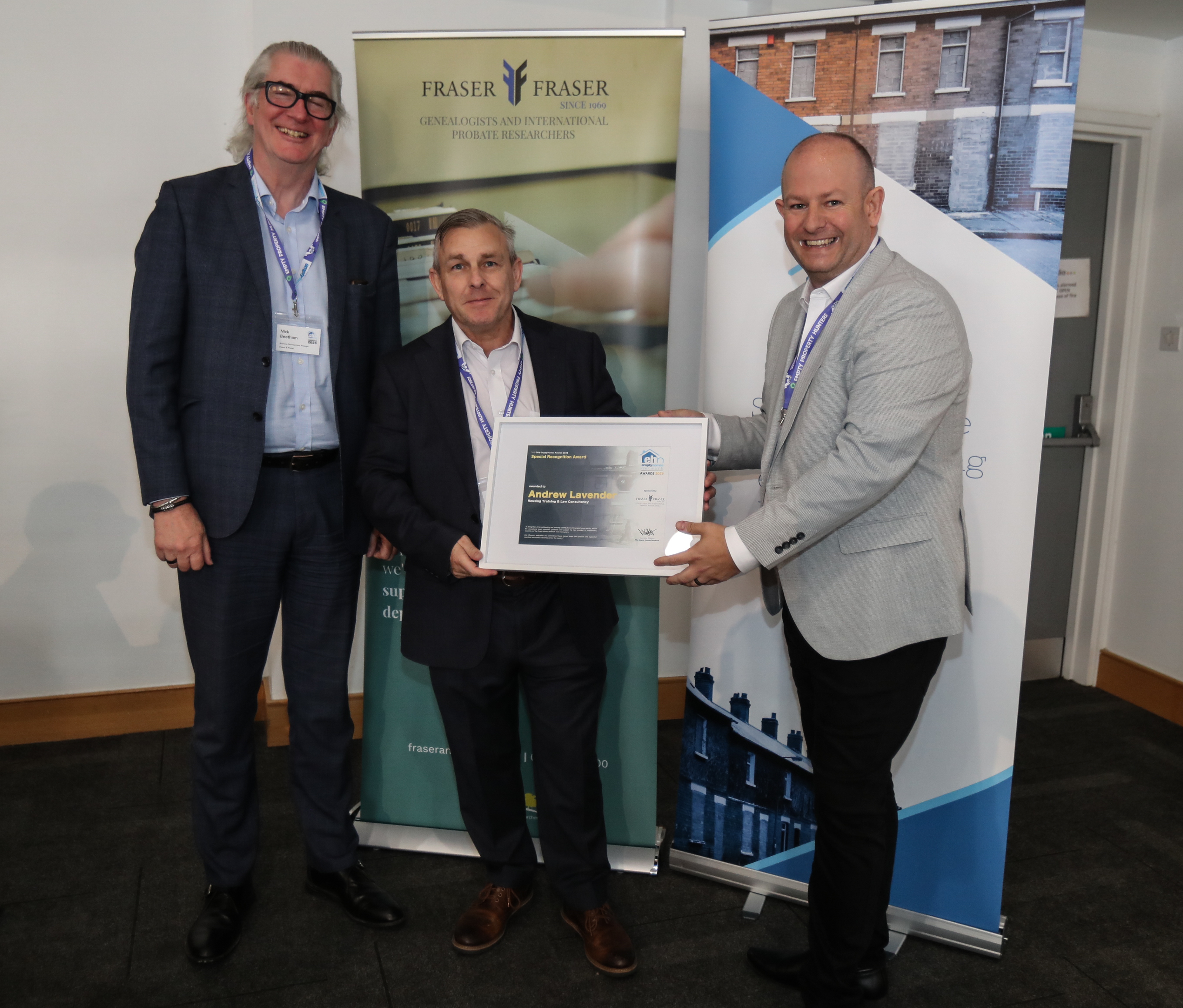
This year’s Special Recognition Award is presented to Andrew Lavender in recognition of his outstanding contribution to the empty homes sector over many years.
Through his exceptional legal expertise, guidance and unwavering support, Andrew has helped shape the way local authorities, practitioners and the Empty Homes Network approach enforcement, policy and practice across the country.
His knowledge and experience have played a critical role in countless successful outcomes, helping officers navigate some of the sector’s most complex and challenging cases with confidence and clarity.
Andrew’s influence extends far beyond individual cases. Through his continued support to councils, governments, the Network and practitioners, particularly through his highly valued enforcement surgeries, he has become one of the sector’s most trusted and respected voices.
His dedication, generosity with his time and commitment to supporting others continues to leave a lasting legacy on empty homes work nationwide.
With sincere gratitude and appreciation, we are proud to present this year’s Special Recognition Award to Andrew Lavender.